
[ad_1]
When a customer asks, “do you have anything gluten free?” at breakfast, they are not asking for a token concession. They are telling you whether they will come back. Coeliac customers and those actively avoiding gluten are not a fringe group in Australian cafés; they are a regular part of any morning trade. What they find on the menu determines whether your café becomes a reliable option or a place they stop recommending.
The backbone of a purposeful gluten-free breakfast offering is not a dedicated fryer or a separate prep area. It is the right cereal base, and what you build around it.
Why does a single gluten-free option cost you more than it saves?
A wrapped muffin in a basket next to the register signals that gluten-free customers are an afterthought. Customers with coeliac disease or significant gluten sensitivity read menus carefully, and one item, particularly a packaged item, does not build confidence. It also does not generate repeat visits, and it does not travel by word of mouth.
Gluten-free customers who find a café that handles their dietary needs well tend to be highly loyal and actively refer others. A breakfast menu with three or four genuinely gluten-free options built from the same core ingredients (granola, fruit, yoghurt, acai) is not meaningfully more complex to run than one poorly considered option. The preparation overlap is high, the storage requirement is minimal, and getting the base right is where the work actually starts.
Who is the gluten-free breakfast customer?
The gluten-free breakfast customer is not a single type. At one end is the coeliac customer, for whom consuming gluten causes a serious autoimmune response. Coeliac disease affects roughly one in seventy Australians, and many more are undiagnosed. These customers are not choosing to avoid gluten; they have no option. They are also the most attentive readers of menus and the most likely to ask staff questions before ordering. Getting it right for them requires both the right ingredients and the right preparation.
Beyond coeliac customers, a larger group avoids gluten for reasons of sensitivity or personal preference: those who experience digestive discomfort with gluten, those following specific dietary approaches, and those who simply feel better without it. This group is less exacting than coeliac customers but still notices when a café has thought about them and when it has not.
What both groups share is that they remember. A café that serves a genuinely good gluten-free breakfast, rather than something that reads as an obligation, earns a particular kind of loyalty. These customers return, they bring others, and they leave reviews that mention it specifically. They are also, increasingly, not eating alone: a table of four at breakfast often includes one person whose dietary needs determine where the group goes.
What makes a gluten-free breakfast menu work?
The difference between a gluten-free offering that sells and one that does not is rarely the food itself. It is where and how that food appears on the menu.
Integration, not segregation
A gluten-free section tucked at the bottom of a breakfast menu, or worse, a separate laminated sheet, tells the customer they are an edge case. It also reduces the likelihood that anyone at the table who does not need gluten-free will order from it, which limits sales. Gluten-free items that sit in the main menu, clearly labelled alongside everything else, sell to a broader group: to the coeliac customer who needs them, to the gluten-sensitive customer who prefers them, and to the curious customer who simply wants what sounds good.
Fewer items done well
A long list of gluten-free options made with weak or generic ingredients is less useful than three or four items built on a strong base. The quality of the food is what creates the repeat customer, not the number of options. A granola bowl, an acai bowl, and a yoghurt parfait, all built on the same well-chosen gluten-free granola, cover the main breakfast formats and the main dietary overlaps — vegan, dairy-free, low sugar — without requiring separate ingredient lines for each.
The anchor ingredient
The choice of granola or cereal base determines what is possible across formats. A gluten-free granola that holds its texture in a bowl, tolerates moisture in a parfait, and complements fruit across different seasonal combinations gives a kitchen genuine flexibility. One that performs poorly in any of these context’s limits what the menu can credibly offer.
What makes Maple Nut Crunch Gluten Free the right base for a café gluten-free breakfast menu?
Plum Foods’ Maple Nut Crunch Gluten Free is the gluten-free version of the original Maple Nut Crunch, one of Australia’s best-known café granolas and a Great Taste Awards gold medal winner. The gluten-free version carries the same flavour profile: maple syrup, almonds, pepitas, and cinnamon, with dried apricots adding a mild tartness. It is a loose, crunchy, handmade granola that is also vegan and low in sugar.
The base is built on quinoa flakes, puffed buckwheat, puffed rice, and sorghum, none of which contain gluten. Almonds and pepitas add density and fat. Maple syrup gives the granola a clean, rounded sweetness without refined sugar. Dried apricots add chew and a mild tartness that offsets the sweetness of the maple.
It is also vegan and low in sugar, which means a single product covers the gluten-free, vegan, and low-sugar requests that arrive at the counter most mornings. Plum Foods is an Australian-made brand, and the product is a Great Taste Awards gold medal winner, with credentials that carry weight on a menu description and on signage.
How does Maple Nut Crunch Gluten Free work across breakfast formats?
A single well-chosen granola can anchor a gluten-free breakfast offering across several formats without adding meaningful prep complexity. Maple Nut Crunch Gluten Free earns its place across all of them.
Granola bowls
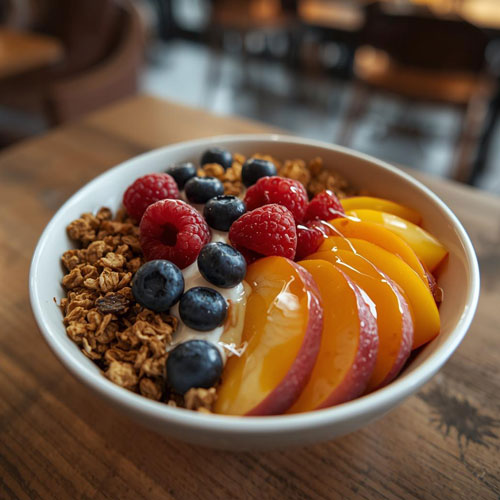
Maple Nut Crunch Gluten Free brings the textural contrast a granola bowl depends on. The crunch of puffed buckwheat and quinoa flakes, the richness of almonds and pepitas, against cool yoghurt and soft fruit. Served over coconut or dairy yoghurt with stone fruit or berries and a light honey drizzle, it is a complete bowl. For coeliac customers, the ingredient composition matters as much as the flavour, and both are addressed here.
Acai bowls
Maple Nut Crunch Gluten Free works over an acai base for the same reasons it works in a bowl: the maple and almond flavours hold their own against the tartness of the acai without dominating it. Provided the acai base and any other toppings are also gluten free, the entire bowl can carry a gluten-free claim on the menu. For the customer ordering acai, a gluten-free labelled bowl removes a question they would otherwise have to ask.
Yoghurt parfaits
The parfait is where the weight of a granola matters. A light, fine granola can disappear into the yoghurt layer; Maple Nut Crunch Gluten Free, with its almonds and pepitas, holds its presence. In a refrigerated cabinet parfait assembled hours before service, the crunch will soften somewhat, but the flavour and body of the granola carry through.
Smoothie toppers
A small portion of Maple Nut Crunch Gluten Free over a smoothie bowl adds crunch and visual texture at low additional cost. For customers who are not ordering a full bowl, it extends the format without requiring a separate product. The almond and maple flavour profile is compatible with most fruit-based smoothie combinations.
How do you write gluten-free menu descriptions that actually sell?
Menu language does more work than most café operators give it credit for. For a gluten-free customer, the description of a dish is the first point of trust. Vague language erodes that trust before the food arrives; specific language builds it.
“Gluten-free option available” tells the customer almost nothing. It does not say which item is gluten free, what it is made from, or whether it has been prepared with any care. A coeliac customer reading that phrase still has to ask questions, which creates friction and uncertainty that many will resolve by ordering elsewhere.
“Granola bowl with Maple Nut Crunch Gluten Free, coconut yoghurt, seasonal fruit, and honey” tells a different story. It names the granola, which signals that the café knows what is in it, specifies the yoghurt, which signals that the dairy question has been considered. And, it describes the build, which lets the customer make an informed decision without having to interrogate the staff.
The same principle applies to any gluten-free item on the menu. Named ingredients over generic claims. Specific preparation details where they are relevant. A description that reads as considered rather than obligatory. This is what turns a gluten-free listing into something a customer wants to order, rather than something they settle for.
Getting it right
The cafés that get gluten-free breakfast right are not doing anything complicated. They have chosen a strong base ingredient, built a small number of formats around it, put those formats on the main menu with descriptions that do the work, and let the food speak for itself. That is what turns a dietary request into a reliable part of the morning trade.
A gluten-free breakfast menu is only as good as the ingredient at its centre. Browse the Opera Foods gluten-free granola and cereal range and find the base that works for your menu.
This article was reproduced on this site with permission from operafoods.com.au the “Wholesale Café Suppliers”.
See original article:- How to Build a Gluten-Free Breakfast Menu
The post How to Build a Gluten-Free Breakfast Menu appeared first on Plum Organic Cereals.
[ad_2]
Source link